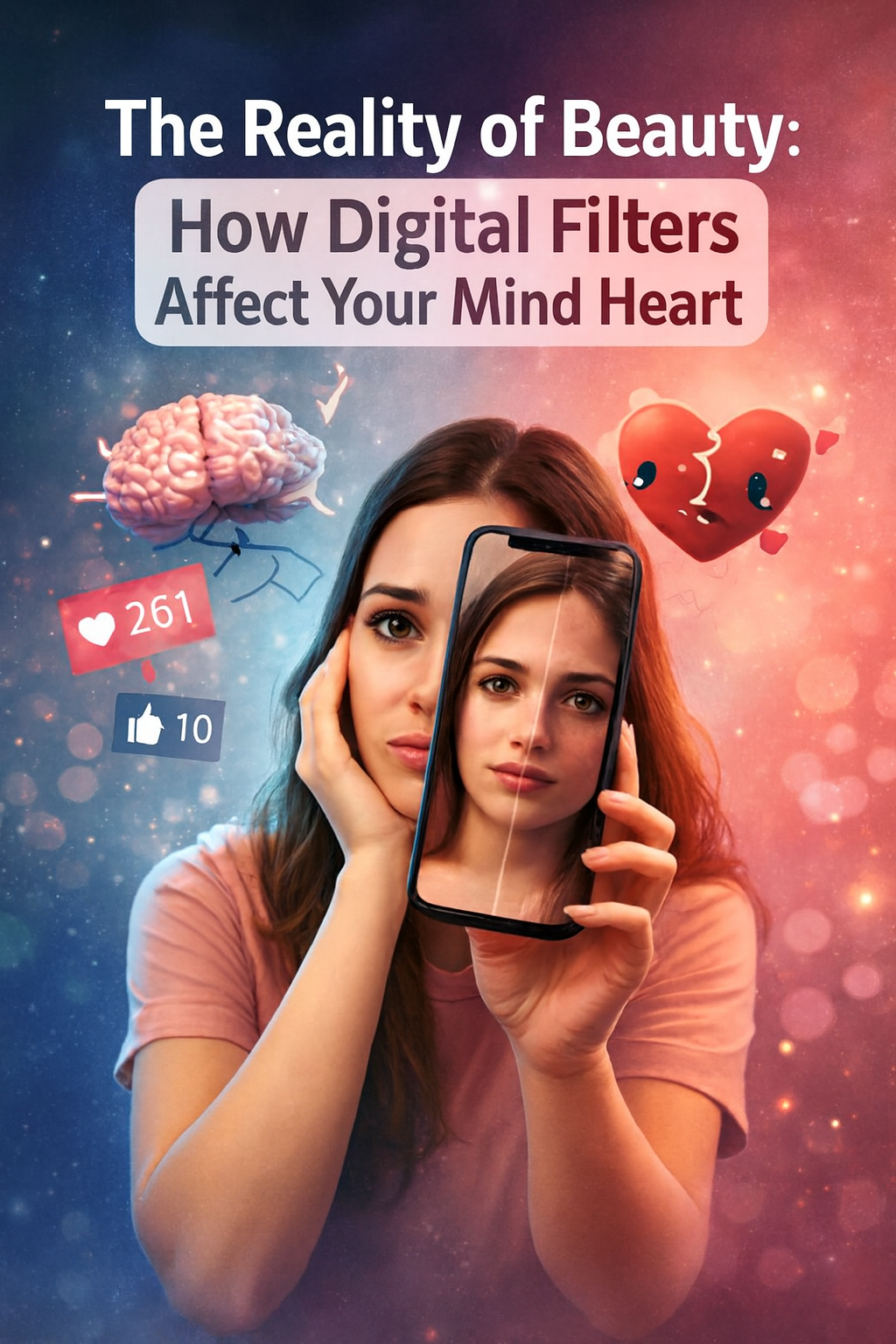
The Reality of Beauty: How Digital Filters Affect Your Mind and Heart
Introduction
The idea of what is considered beautiful has always changed over time, influenced by culture, society, and historical context. However, with the rapid growth of the internet and the widespread use of social media, a new factor has begun to shape how we see ourselves: digital filters. These are the effects used on photos and videos to alter facial features, smooth skin, and sometimes even make a person look like someone else entirely.
At first, filters may seem harmless or even playful. However, frequent use can significantly affect our mental and emotional well-being.
The constant pursuit of the “perfect photo” encourages comparison, dissatisfaction with appearance, and even a distorted self-image. Studies indicate that excessive use of beauty filters is associated with higher levels of body dissatisfaction, anxiety, and low self-esteem—especially among adolescents and young adults. For this reason, it is essential to discuss the concept of real beauty and understand how to balance technology, mental health, and overall well-being.
In this article, we explain how digital filters affect the mind, influence self-esteem, body image, relationships, and mental health, and we also offer guidance on how to use these tools in a more conscious and healthy way.
What Are Digital Filters and How Do They Work?
What are digital filters?
Digital filters are software tools that modify photos and videos either in real time or after they are taken. They can adjust colors, lighting, skin texture, and even reshape facial features, creating a significantly altered appearance.
These filters are widely used on social media platforms for self-expression, entertainment, and online identity construction.
Types of filters
There are many types of digital filters, including:
-
Beauty filters: Smooth skin, remove imperfections, and alter facial proportions.
-
Augmented reality filters: Add virtual elements to the face or environment.
-
Artistic filters: Transform images into drawings or artistic styles.
-
Correction filters: Adjust brightness, contrast, and sharpness.
While some filters are subtle, others drastically change appearance, creating unrealistic beauty standards that do not exist in real life.
What Is Real Beauty?
What does it mean?
Real beauty refers to valuing natural appearance regardless of body type, facial features, age, skin tone, or other individual characteristics. Unlike the idealized standards promoted by filters, real beauty acknowledges imperfections as a natural part of being human.
This concept has gained strength through social movements and campaigns that promote self-acceptance and positive body image.
Real beauty vs. digital beauty
Digital filters often promote a single, standardized beauty ideal: flawless skin, symmetrical features, and uniform facial structures. This contrasts sharply with real beauty, which embraces diversity and individuality.
How Do Digital Filters Affect Our Mind?
Self-esteem
Self-esteem is closely linked to how we perceive and evaluate ourselves. When filters are used excessively, people may begin comparing their real appearance to their filtered version, leading to:
-
Dissatisfaction with one’s natural appearance
-
Feelings of inadequacy
-
Dependence on filters to feel confident in public
Over time, this can undermine self-confidence and self-acceptance.
Self-image
Continuous exposure to filtered images can distort self-perception, causing individuals to view themselves in an overly critical or negative way. In more severe cases, this may contribute to psychological conditions such as body dysmorphic disorder.
Anxiety
Social media encourages constant comparison. When most images are filtered, individuals compare their real appearance to unrealistic versions of others, increasing anxiety and stress.
Common consequences include:
-
Fear of appearing without filters
-
Obsession with likes and comments
-
Persistent feelings of unattractiveness
Adolescents
Adolescents and young adults are particularly vulnerable because they are still forming their identity and self-esteem. Research shows that excessive filter use during this stage can negatively affect emotional development and self-image.
Filters and Mental Health
Psychological issues
Uncritical and excessive filter use may contribute to:
-
Anxiety disorders
-
Depression
-
Eating disorders
-
Body dysmorphia
Although filters are not the sole cause, they can intensify existing vulnerabilities.
Unrealistic beauty standards
As filters become normalized, natural appearance may be perceived as inadequate. This unrealistic expectation affects not only individuals but society as a whole, reinforcing beauty ideals that are impossible to achieve.
How Does This Affect Our Relationships?
Online vs. real life
The gap between online appearance and real-life appearance can create insecurity during face-to-face interactions, negatively affecting relationships. Some people report feeling disconnected from their real identity outside the digital world.
Social pressure
The pressure to meet online beauty standards encourages excessive filter use as a way to seek acceptance. This creates a cycle of dependence on external validation.
How to Use Filters in a Healthy Way
Critical thinking
Understanding that filters are editing tools—not reality—is essential. Developing critical thinking skills helps reduce their negative impact on self-esteem.
Practical tips
Healthy practices include:
-
Reducing the use of beauty filters
-
Following accounts that promote real beauty and diversity
-
Reflecting on the reasons for using filters
-
Seeking professional help if emotional distress arises
The role of social media platforms
Social media companies also have a responsibility to minimize harm by:
-
Labeling filtered images
-
Promoting awareness campaigns about digital self-image
Frequently Asked Questions (FAQ)
1. Can digital filters cause psychological problems?
They do not directly cause disorders, but they can contribute to low self-esteem and anxiety.
2. Is using digital filters always harmful?
No. The problem lies in excessive use and emotional dependence.
3. Should children and adolescents use filters?
Use should be supervised and accompanied by guidance on body image and self-esteem.
4. Is there a link between filters and eating disorders?
Yes, especially when filters reinforce unrealistic body standards.
5. How can we promote real beauty on social media?
By valuing diversity, authenticity, and content without excessive editing.
Conclusion
Digital filters are part of modern life and, when used responsibly, can be a form of creativity and fun. However, excessive reliance on filtered appearances can harm self-esteem and mental health. Real beauty challenges this mindset by encouraging acceptance of diversity and individual traits.
Understanding how filters affect our minds allows us to make healthier choices—both in how we use them and how we consume online content. Information, digital education, and critical thinking are essential to balancing technology, well-being, and quality of life.
References
Impact of social media filters on body perception and psychological well-being
DW, B. H.; Subriadi, A. P. The Impact of Social Media Filters on Body Perception and Psychological Well-Being in Adolescent Girls: A Systematic Literature Review. In: Proceedings of the 6th International Conference on Informatics, Multimedia, Cyber and Information System (ICIMCIS 2024). Institute of Electrical and Electronics Engineers (IEEE), 2024.
Available at: https://scholar.its.ac.id/en/publications/the-impact-of-social-media-filters-on-body-perception-and-psychological-well-being-in-adolesce
Accessed on: January 28, 2026.
Social media and body image concerns: experimental evidence
Fardouly, J.; Diedrichs, P. C.; Vartanian, L. R.; Halliwell, E. How Exposure to Beauty Ideals on Social Networking Sites Influences Body Image: A Systematic Review of Experimental Studies. Adolescent Research Review, v. 7, pp. 419–458, 2022.
Available at: https://link.springer.com/article/10.1007/s40894-022-00179-4
Accessed on: January 28, 2026.
Social media use and mental health in the digital age
Author(s). Navigating the Relationship Between Social Media Use and Mental Health in the Digital Age. Discover Mental Health, Springer Nature, 2025.
Available at: https://link.springer.com/article/10.1007/s44192-025-00285-4
Accessed on: January 28, 2026.
Negative impacts of social media on body image dissatisfaction and mental health
AlQahtani, A.; Shaikh, S.; Ahmad, A.; Alhusseini, A. Impact of Social Media on Mental Health and Body Image Dissatisfaction Among Saudi Women. PubMed, 2025.
Available at: https://pubmed.ncbi.nlm.nih.gov/41487080/
Accessed on: January 28, 2026.


Você pode gostar
Who should not use Mounjaro and what options are available
After all, what is the difference between a beauty treatment and a medical treatment?