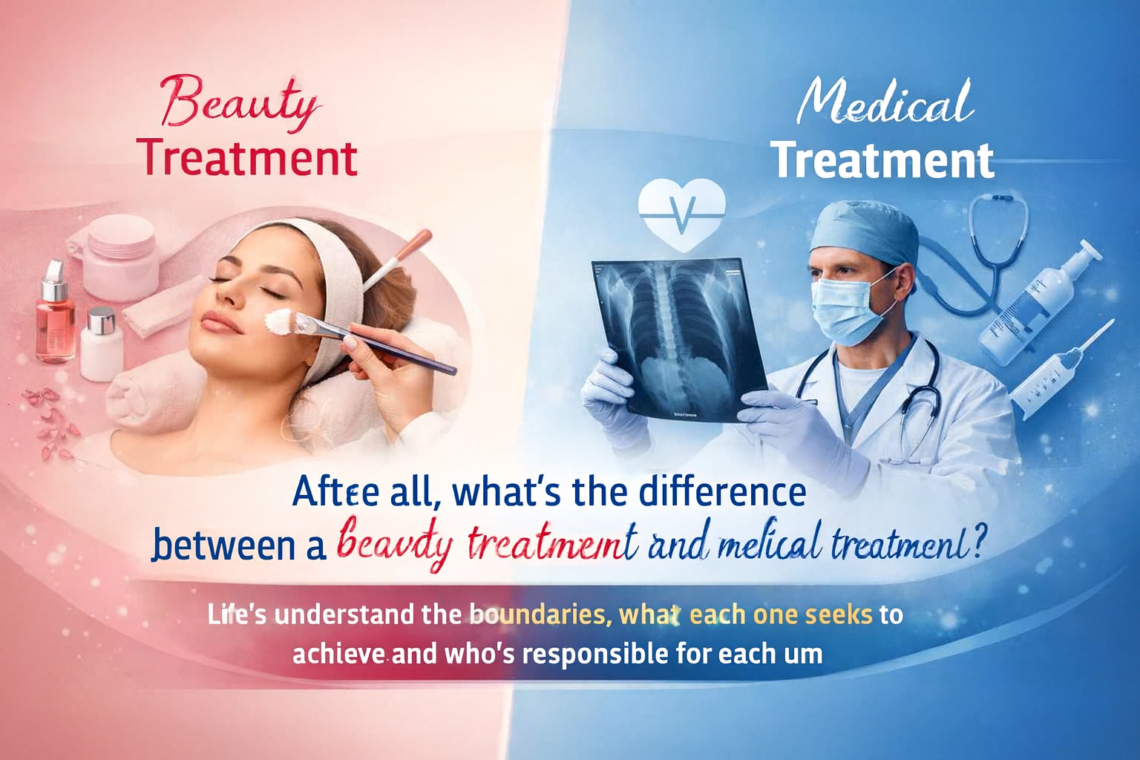
After all, what is the difference between a beauty treatment and a medical treatment?
To begin with
We have seen more and more people looking for procedures to improve their appearance. This trend is influenced by social media, technological advances, and easier access to health and beauty services. However, in the middle of all this, confusion has arisen between beauty treatments and medical treatments. Many people think they are the same thing—but they are not. Each one has its own rules, limitations, risks, and responsibilities. This confusion can lead people to make the wrong choices, develop unrealistic expectations, and, in more serious cases, put their health at risk.
Understanding this difference is essential to making safe decisions that are aligned with what the body truly needs. One focuses on improving appearance and boosting self-esteem, while the other is designed to diagnose conditions, prevent health problems, and treat diseases, following strict medical guidelines.
In this text, we will clearly explain what each type of treatment involves, who is allowed to perform it, the risks involved, what the law says, and why it is so important to know the difference—always with patient safety in mind. Everything is explained in a simple and clear way, with links for those who want to explore the topic further.
What is a beauty treatment?
A beauty treatment includes procedures aimed at improving appearance, increasing self-esteem, and promoting well-being. Its purpose is not to cure diseases, but to enhance physical appearance—whether related to the skin, hair, body, or signs of aging.
These procedures are generally less invasive and do not significantly interfere with the body’s internal systems or existing medical conditions. The goal is to enhance appearance, prevent premature aging, and maintain a healthy look.
Some examples include:
-
Facial cleansing
-
Basic chemical peels
-
Manual lymphatic drainage
-
Relaxing and shaping massages
-
Facial treatments for mild acne or oily skin
-
Non-invasive body procedures
-
Hair care treatments
When performed by a qualified professional and within legal limits, the risks are usually low.
Who can perform beauty treatments?
Beauty treatments can be performed by professionals who are trained and legally authorized, such as:
-
Estheticians
-
Cosmetologists
-
Licensed aesthetics professionals
-
Physiotherapists (in specific areas)
-
Biomedical professionals working in aesthetics (according to regulations)
Each of these professionals has defined limits of practice established by law and professional regulatory bodies.
What are the limits of beauty treatments?
Beauty treatments do not replace medical treatments. They are not intended to:
-
Diagnose diseases
-
Prescribe medications
-
Treat medical conditions
-
Promise cures or medical results
If there is any suspicion of illness, the individual must seek a medical professional.
What is a medical treatment?
A medical treatment is intended to diagnose conditions, prevent illness, manage health problems, and treat diseases. It is based on scientific evidence, clinical guidelines, and regulations established by health authorities.
Unlike beauty treatments, medical treatments involve a thorough evaluation of the patient, diagnostic tests, and close follow-up.
Some examples include:
-
Treatment of skin diseases (severe acne, psoriasis, dermatitis, allergies)
-
Plastic surgery for medical or reconstructive purposes
-
Prescription of medications
-
Treatment of hormonal disorders
-
Invasive procedures
-
Management of chronic diseases
These procedures can only be performed by licensed physicians, who must follow strict ethical and legal standards.
Who can perform medical treatments?
Only physicians registered with the Regional Medical Council (or equivalent medical board) are authorized to:
-
Diagnose diseases
-
Prescribe medications
-
Perform invasive procedures
-
Manage clinical and surgical treatments
This ensures patient safety and quality of care.
Responsibilities and risks of medical treatment
Medical treatments carry higher risks because they directly affect the body’s functioning. For this reason, they require:
-
Informed patient consent
-
Detailed clinical evaluation
-
Continuous monitoring
-
Legal and ethical accountability
| Aspect | Beauty Treatment | Medical Treatment |
|---|---|---|
| Purpose | Improve appearance | Treat or prevent diseases |
| Diagnosis | No | Yes |
| Medication prescription | No | Yes |
| Invasiveness | Rarely invasive | May be invasive |
| Who performs it | Esthetic professionals | Physician |
| Regulatory body | Specific professional councils | Medical Council |
| Approach | Preventive and cosmetic | Clinical evaluation, exams, risk assessment |
Understanding these differences is essential for safety, realistic expectations, and accountability.
When can beauty treatments complement medical treatments?
In many situations, beauty and medical treatments can complement each other, as long as professional boundaries are respected.
Examples include:
-
Aesthetic care after dermatological treatment
-
Beauty procedures after surgery (with medical approval)
-
Maintenance treatments for healthy skin
Clear communication between professionals is essential.
What happens when beauty treatments are confused with medical care?
This confusion can lead to serious consequences, such as:
-
Delayed diagnosis of diseases
-
Health complications
-
Improper procedures
-
Unrealistic promises of results
-
Legal and ethical issues
That is why patients must know who is performing the procedure and the real objective of the treatment.
How to choose the right treatment
Before starting any procedure, it is advisable to:
-
Verify the professional’s qualifications and registration
-
Clearly understand the purpose of the treatment
-
Ask about risks and benefits
-
Be cautious of unrealistic promises
-
Seek a second opinion if necessary
Frequently Asked Questions
1. Can beauty treatments replace medical treatments?
No. Beauty treatments do not treat diseases and do not replace medical care.
2. Can an esthetician treat acne?
Only mild cases. Moderate to severe acne requires medical follow-up.
3. Are beauty procedures always safe?
No. They can carry risks if performed by unqualified professionals.
4. Do medical treatments always involve surgery?
No. Many medical treatments are non-invasive and medication-based.
5. Can I undergo beauty treatments during medical treatment?
Yes, as long as the physician approves.
Conclusion
The difference between beauty treatments and medical treatments is essential for safety, ethics, and overall health. While beauty treatments focus on appearance and well-being, medical treatments are designed to diagnose and treat diseases.
Understanding these limits helps individuals make better decisions, avoid unnecessary risks, and build transparent relationships with health and beauty professionals. Information is the best tool to ensure safe, responsible outcomes aligned with the body’s real needs.
References (with reliable links)
Difference between aesthetic treatments and medical procedures (technical explanation)
Clinical Cosmetology vs. Aesthetic Treatments: Understanding the Distinctions.
Available at: https://iicad.org/clinical-cosmetology-vs-aesthetic-treatments-understanding-the-distinctions/
Accessed on: [30/01/2026].
Importance of aesthetic procedures being performed by medical professionals
Why Aesthetic Treatments Should Be Done by Doctors Only.
Available at: https://www.lmaclinic.com/lma/blog/aesthetic-treatments-doctors-vs-beauticians
Accessed on: [30/01/2026].
Difference between medical aesthetics clinics and spas/beauty salons
What Is the Difference Between a Medical Aesthetics Clinic and a Spa or Beauty Salon?
Available at: https://ageless-aesthetics.webflow.io/news/what-is-the-difference-between-a-medical-aesthetics-clinic-and-a-spa-or-beauty-salon
Accessed on: [30/01/2026].
Examples of when aesthetics becomes a medical intervention (e.g., injectables)
Why Injectables Are Medical Treatments, Not Beauty.
Available at: https://www.harleyacademy.com/aesthetic-medicine-articles/why-injectables-are-medical-treatments-not-beauty/
Accessed on: [30/01/2026].
Technical definition of “treatment” in a medical context (dictionary)
Treatment – Infopédia Medical Terms Dictionary.
Available at: https://www.infopedia.pt/dicionarios/termos-medicos/tratamento
Accessed on: [30/01/2026].

Você pode gostar
Mistakes That Ruin Facial Harmonization Results: What to Avoid for Safe and Natural Outcomes
Who should not use Mounjaro and what options are available